Blog

  • Fake ID Checker: How Experts Really Spot Fake IDs in the United States

    Fake ID Checker: How Experts Really Spot Fake IDs in the United States

    If you’ve ever worked at a bar, a liquor store, or any place that requires checking IDs, you already know how unpredictable the experience can be.

    Some nights, the IDs people hand you are so obviously fake that you can’t help but smile. Other nights, someone hands you a card that looks perfect until you tilt it just right or feel something strange under your thumb. That tiny detail the way the card bends, the way the photo looks a little too “studio-perfect,” or the way the hologram doesn’t behave like it should is often all it takes to expose the truth.

    Real ID checking isn’t about accusing people or making things harder. It’s about safety, compliance, and understanding how U.S. identification works. A proper fake ID check is far more than a quick glance or a barcode scan. It’s a layered process part instinct, part training, and part attention to small details that most people never think about.

    Today, in this post, I’ll show you how professionals detect fake IDs in the United States, using techniques grounded in real-world experience.

    What a “Fake ID Checker” Actually Means?

    Most people think a fake ID checker as a magical machine or smartphone app that instantly says whether an ID is real. But the truth is a bit more practical and a lot more human.

    A fake ID checker is not a device. It’s a method a combination of:

    • visual inspection
    • understanding of DMV standards
    • texture and material recognition
    • behavior reading
    • barcode validation
    • and sometimes, specialized scanning equipment

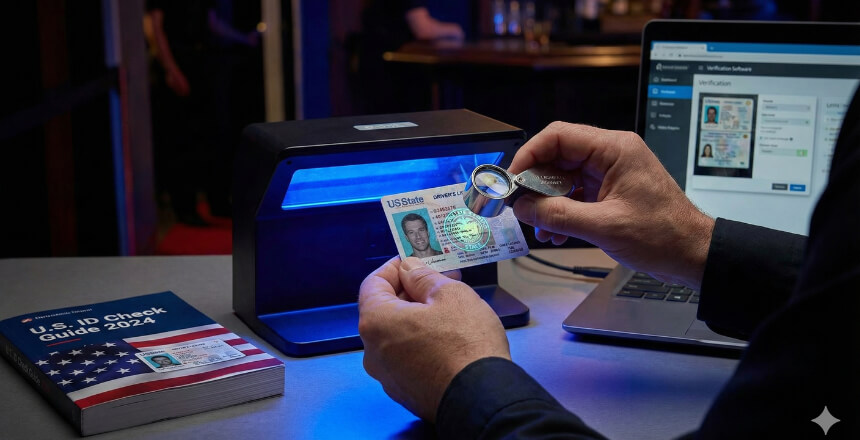
    Ask any experienced bouncer, bartender, or retail worker, and they’ll tell you that no single tool can catch every fake. Instead, it’s the combination of multiple small checks done quickly and consistently that catches most counterfeit IDs.

    Must Read: Fake ID Vs Novelty ID – Know the Difference

    How Experts Use Visual Checks to Spot Fake IDs

    If you’ve handled enough real IDs, you develop a sixth sense. The moment a card touches your hand, something in your brain either relaxes or tightens. A real license has a certain firmness, a certain surface feel, and a layered construction that cheap fakes almost never replicate.

    Texture: The Feel of a Real ID vs. a Fake

    A real U.S. driver’s license is built with multiple layers of polycarbonate or advanced laminate materials. When you bend it, it doesn’t flop like a hotel key card, nor does it resist like a credit card. It has a controlled flexibility you can’t fake easily. You can feel raised text under your fingertips especially on newer REAL ID compliant cards.

    On the other hand, fake IDs feel too smooth, too rubbery, strangely thin and unnaturally stiff. This is why some professionals say, “I know it’s fake before I ever look at the photo.”

    Color and Layout: The Details That Fake IDs Don’t Get Right

    Every U.S. state follows incredibly strict guidelines for layout, font weight, spacing, background gradients, and emblem placement. When you’ve seen enough real IDs from your state, these patterns imprint themselves in your mind.

    Fake IDs tend to slip in subtle ways:

    • the gradient is too sharp
    • the state emblem is too dark or too bright
    • the font size is slightly off
    • spacing around the photo feels wrong

    These are small things, but they matter. Real IDs look clean, consistent, and precise. Fakes often look like they’re “trying too hard” or missing some refinement.

    Photo Alignment: A Common Giveaway

    DMV photos look like DMV photos boring, flat, evenly lit, and a little lifeless. They don’t have shadows from ring lights or softbox glow. The background isn’t artistic or edited.

    Fake IDs often use photos pulled from a phone gallery, which means:

    • the lighting looks too warm
    • the background is uneven
    • shadows appear behind the head
    • the person looks professionally photographed

    Even the cropping can be off. DMV software places the face in a very specific position; counterfeiters rarely match this perfectly.

    Security Features: The “Hidden Layers” Real U.S. IDs Use

    Security features are where most fakes collapse. U.S. driver’s licenses aren’t printed like normal cards they’re engineered using specialized material, UV-reactive ink, holographic overlays, laser engraving, and microprint. Replicating these features requires equipment that counterfeiters rarely have.

    Holograms: The Movement That Gives Them Away

    Real holograms are embedded into the card using optically variable devices. When tilted under light, they change color and depth in a very smooth, controlled way. You can almost feel the hologram reacting with the light.

    Fake holograms often look static. They may reflect light, but they don’t “move.” Sometimes they look printed on top of the card instead of being fused into the surface. Once you’ve seen the real movement, the fake becomes obvious.

    UV Ink: The Hidden Patterns Only Blacklight Reveals

    Under UV light, real IDs come alive. State seals glow, patterns appear, and hidden details show up that you never see under normal lighting. These designs are intentional and follow precise rules set by each state.

    Fake UV features often glow wrong:

    • too bright
    • too weak
    • incorrect shape
    • in the wrong parts of the card

    Good counterfeiters try to replicate them, but very few succeed perfectly.

    Microprinting: One of the Toughest Features to Copy

    Microprinting is tiny text so tiny that you need a magnifier to see it clearly. On a real ID, microprint looks crisp. On a fake ID, it usually looks smudged, pixelated, or broken. This is because the printers used for fake IDs simply can’t generate that level of clarity.

    The Real Role of Barcode and Magnetic Stripe Checking

    Barcode scanning sounds high-tech, but most people misunderstand what it actually does. Retail scanners, bar scanners, and age-verification devices don’t connect to DMV systems. They aren’t checking a database. They’re checking formatting.

    Here’s what a scanner does:

    • reads the barcode
    • pulls up encoded data
    • matches it to what’s printed

    If the scanner reads a different birthdate than the one printed, or the postal code doesn’t match the state’s formatting rules, the card becomes suspicious.

    High-quality fake IDs sometimes pass barcode scans, but when scanned across multiple systems or checked against holograms or microprinting, they often fail the full verification process.

    Why Online Fake ID Checkers Don’t Work

    No website can connect to any official U.S. DMV database.

    Privacy laws and federal regulations make that impossible.

    So any “fake ID checker” website you see online can only:

    • guess based on field formatting
    • check if the barcode follows basic AAMVA rules
    • compare visible template patterns

    But it cannot confirm whether the ID was actually issued by a state.

    No real authority offers public online validation, and any site claiming otherwise is misleading users.

    Fake ID Checker Apps: Helpful but Limited

    Apps are useful for quick checks, but they’re not magic. Most focus on the barcode:

    Is the formatting correct?

    Does the expiration date make sense?

    Does the birthdate match the printed one?

    But they cannot read microprinting, UV features, holograms, or lamination quality. They also cannot detect whether the person holding the ID looks like the photo.

    Apps are tools not solutions.

    How Bouncers Actually Check IDs (Expert Reality)

    Spend any time talking to experienced bouncers and you’ll hear the same thing:

    “I don’t look at the photo first. I feel the card first.”

    A typical ID check takes only a few seconds, but a lot happens in that time:

    Texture check feel the card’s flexibility and surface. If it’s wrong, the process is already halfway done.

    • Light test – They tilt it to see how the hologram reacts. It either behaves correctly or it doesn’t.
    • Data check – They glance at the DOB and visually cross-check the formatting and picture.
    • Behavior check – They ask simple questions. The wrong hesitation exposes many fakes.
    • Facial structure comparison – They don’t look at hair or style they look at the shape of the jaw, nose, and eyes. These things don’t change.

    What looks like a “casual check” to others is actually a quick, practiced routine developed through experience.

    Why Fake IDs Fail in Real Life

    Even high-quality fakes show tiny flaws that accumulate:

    • the laminate edge doesn’t fuse correctly
    • the ghost image sits a millimeter too low
    • the spacing around the portrait is slightly off
    • the barcode formatting doesn’t match the issuing state
    • the microprint looks blurry
    • the UV pattern glows unevenly

    None of these details alone always prove a fake, but together they paint a clear picture.

    This is why human inspection catches things machines often miss.

    Why Proper ID Checking Matters

    In the U.S., checking IDs isn’t just a routine step it’s a safeguard. Allowing minors into age-restricted spaces creates real risks.

    Businesses can lose their licenses or face large fines. But beyond business consequences, proper ID checks also prevent identity theft, impersonation, fraud, and unsafe situations for vulnerable individuals.

    A good ID check protects the venue, the customers, and the people presenting the ID whether they’re genuine or not.
  • Fake ID vs Novelty ID — Know The Real Difference

    Fake ID vs Novelty ID — Know The Real Difference

    Most people have seen both fake IDs and novelty IDs online, but very few understand how different they really are.

    Because, both look like small plastic cards same size, similar thickness, bold text, photos, and sometimes even barcodes.

    But in the United States, the distinction between them is not just a design difference; it’s a matter of intent, legality, and real-world use.

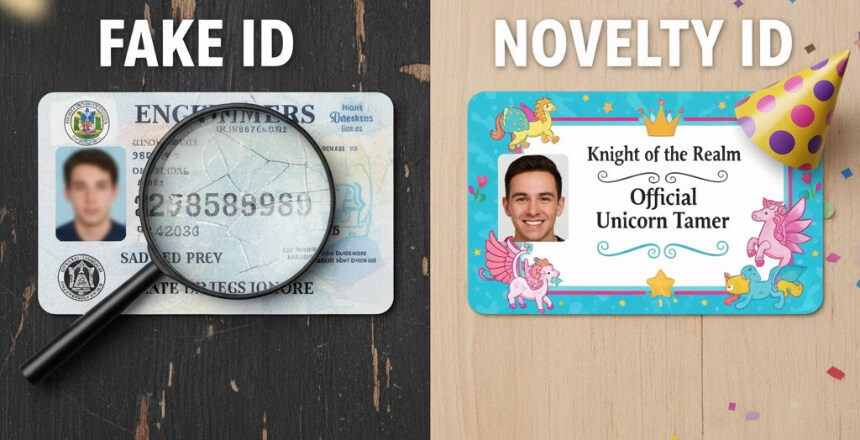
    In simple words, a fake ID is a card intentionally designed to imitate a real U.S. government-issued ID and deceive someone checking it. While, A novelty ID is a fictional or playful card used for fun, props, cosplay, or entertainment, with no intention of replacing a real ID.

    In this guide, I’m going to explain the difference between fake id and novelty id along with criteria used by bars, retailers, and security personnel across the country.

    Let’s dive in…

    Fake ID vs Novelty ID: Quick Summary

    CategoryFake IDNovelty ID
    IntentDeception and illegal useEntertainment, props, or gags
    DesignTries to be an exact replica of official IDsFictional look, uses unofficial design
    LegalityIllegal to own or useTypically legal unless misused
    Security FeaturesAttempts realistic holograms, UV, barcodesLacks official security features
    Use CasePassing age checks, impersonationProps, cosplay, fun
    Risk LevelHigh riskVery low unless misused
    DisclaimerNoneOften includes “Not a government document”

    This table reflects exactly how U.S. law enforcement, retailers, and security teams classify identification cards.

    What Is a Fake ID?

    A fake ID is created to pass itself off as an authentic government-issued document such as a driver’s license, state ID, or passport. In the U.S., this means mimicking highly standardized features set by the AAMVA (American Association of Motor Vehicle Administrators) and individual state DMVs.

    Purpose

    The purpose behind a fake ID is always misrepresentation. People typically attempt to use them in age-restricted locations such as bars, clubs, liquor stores, or casinos. Others may use them to impersonate another person entirely. Regardless of the scenario, the intended outcome is deception.

    This intention is what makes fake IDs legally risky.

    Legality

    Under U.S. federal and state law, possessing or using a fake ID is illegal. States like Texas, California, and New York classify it under “fraudulent identification,” which can lead to:

    • confiscation
    • misdemeanor or felony charges
    • fines
    • probation
    • arrest

    In some states, even attempting to use one without successfully passing it can result in legal consequences.

    This is why bouncers, security guards, and retail staff undergo ID verification training. They’re taught to watch for signs that indicate tampering, misprints, or attempts at deception.

    Appearance and Features

    A fake ID tries to replicate design choices made by real U.S. driver’s licenses. Real IDs include:

    • holographic overlays
    • microprinting
    • UV patterns
    • ghost portraits
    • raised text
    • encoded barcodes that link to AAMVA formatting
    • precise spacing and typeface standards

    Most official U.S. IDs contain multiple layers of embedded security. These layers are intentionally difficult for unauthorized printers to copy.

    When someone creates a fake ID, they try to duplicate these same elements so the card passes a quick glance or blacklight check.

    Production Process

    Fake IDs are made using specialized printers, PVC templates, adhesive laminates, and digital templates that copy real state layouts. They often originate from unauthorized sources trying to mirror government standards closely enough to trick scanners or human inspectors.

    This is different from novelty cards, which are created for entertainment not accuracy.

    What Is a Novelty ID?

    A novelty ID is a fictional or humorous card meant for entertainment. Instead of copying a U.S. government template, it uses fictional designs, bright colors, exaggerated titles, or references to movies, games, or imaginary organizations.

    Think McLovin’s Hawaiian license from “Superbad,” or a “Zombie Apocalypse Response Unit” card someone clips to their backpack for fun. These are novelty items, not identification documents.

    Purpose

    Novelty IDs exist for cosplay, humor, props, costumes, themed parties, creative gifts, or social media videos. The key difference from fake IDs is intent. A novelty ID is not created to deceive; it’s meant to be amusing or fictional from the start.

    A teenager using a Hogwarts ID as a bookmark is not trying to pass it off as a government document.

    Legality

    In most U.S. states, novelty IDs are legal because they do not imitate real government documents and usually contain disclaimers such as:

    “This is not a government-issued ID.”

    The legal issue arises only if someone attempts to use a novelty card as a genuine ID or presents it to law enforcement, airport security, or a business. That action not the card itself is where trouble begins.

    Appearance and Features

    Novelty cards often display their fictional nature through:

    • non-government layouts
    • made-up logos
    • playful titles
    • unrealistic color palettes
    • humor-oriented themes
    • cartoon illustrations
    • fictional organizations

    Unlike fake IDs, novelty IDs intentionally avoid replicating holograms, microprinting, or other anti-fraud measures used by U.S. DMVs.

    Production Process

    Most novelty cards are produced through standard printing services. They focus on creativity rather than security, entertainment rather than deception, and fictional elements rather than accuracy.

    Why People Get Confused

    Confusion usually comes from the shape of the card. Both fake and novelty IDs are printed on PVC plastic using standard card dimensions. So when someone sees a novelty card online like a “Space Federation Commander ID” they assume it’s the same category as a fake ID.

    But once you understand two things intent and authenticity the difference becomes obvious.

    A fake ID tries to be real.

    A novelty ID pretends to be fictional.

    How Inspectors Spot Fake IDs

    People checking IDs in bars and clubs don’t memorize every state’s design. Instead, they rely on cues based on DMV and AAMVA verification standards:

    Texture First

    Real IDs feel layered because of the laminate and raised text. Counterfeit cards often feel smooth, rigid, or too flexible.

    Hologram Behavior

    Real holograms shift cleanly under angled light. Fake holograms often appear dull or blurry because they’re printed instead of embedded.

    Barcode Scanning

    Most U.S. IDs follow AAMVA barcode formatting. Fake barcodes often fail to scan or show mismatched data.

    Microprinting

    Genuine microtext is sharply etched. Most counterfeit attempts print fuzzy microtext that smears on close inspection.

    Data Alignment

    Uneven spacing, inconsistent typography, and misaligned edges are all signs of counterfeit production.

    These checks are standard across the U.S. and taught in ID verification courses for retail workers and nightclubs.

    How to Recognize a Novelty ID (Without Mistakes)

    Novelty cards do not require deep inspection because their fictional elements are obvious when viewed through a real-world context.

    A novelty card may include:

    • a fictional organization
    • humorous titles (“Professional Ninja,” “Space Pilot”)
    • unrealistic layouts
    • creative illustrations
    • intentionally playful themes

    These clues make it clear the card is meant for fun, not fraud.

    Why This Distinction Matters

    In the U.S., many people misunderstand the legal boundaries around ID cards. This creates unnecessary fear around harmless novelty items and downplays the serious risk of using a fake ID.

    Understanding the distinction helps you:

    • know what is safe to purchase
    • avoid legal trouble
    • recognize deceptive documents
    • use novelty items responsibly
    • understand U.S. identification standards

    Clear knowledge protects both consumers and businesses.

    How Responsible Designers Stay Compliant

    Designing novelty IDs responsibly takes discipline and policy, not just creativity.

    1. Creative Integrity

    We design from scratch colors, typography, emblems without copying any licensed government template.

    2. Legal Review

    Before publishing a design, our compliance team checks:

    • no state or federal seals
    • no identifiable agency names
    • no barcode data structure match

    3. Transparency in Use

    Our checkout, FAQs, and cards carry visible disclaimers.

    We remind users: “Do not use for identification or verification.”

    4. Privacy by Design

    Uploaded photos and signatures are deleted once your card ships.

    We follow FTC and GDPR-equivalent data-retention policies because creative freedom shouldn’t cost privacy.

    Also Read: Is Having a Fake ID Illegal?

    Frequently Asked Questions

    Are novelty IDs legal in the U.S.?

    Yes. Novelty IDs are generally legal as long as they don’t replicate real U.S. government IDs and are not used to deceive. Their fictional themes and disclaimers separate them from fraudulent identification.

    Is owning a fake ID illegal?

    Yes. In the U.S., possessing or using a fake government ID is illegal under state and federal laws. Even attempting to use one at a bar or store may lead to fines or criminal charges.

    Can bars instantly spot fake IDs?

    Not always. But with training, staff learn to check texture, holograms, microprinting, and barcode behavior methods based on AAMVA and state DMV guidelines.

    Why do novelty IDs exist?

    They exist for entertainment: cosplay, movies, themed events, gifts, humor, and collectibles. They’re meant to look fictional, not official.

    Can someone get in trouble for using a novelty ID incorrectly?

    Yes. Even though the card itself is legal, presenting any non-government card as a real ID can result in legal consequences.

    Final Thoughts Creativity with Integrity

    The gap between a fake ID and a novelty ID isn’t just legal; it’s philosophical.

    One exists to deceive. The other exists to create.

    At FakeIDs.com, every design goes through creative review, legal checks, and privacy controls before it reaches you. Because “looking real” shouldn’t mean “acting real.”

    So whether you’re designing a short-film prop, a collector’s display, or a custom gift do it safely, do it ethically, do it creatively.

    Choose artistry. Choose transparency. Choose trust.

  • Is Having a Fake ID Illegal? A Clear 2026 Guide

    Is Having a Fake ID Illegal? A Clear 2026 Guide

    If you’re asking this, you’re probably not trying to become a criminal.

    You’re just wondering:

    “If I have a fake ID in my wallet and I’m not using it, is that already illegal?”

    The short answer?

    In every U.S. state, fake IDs are treated as a legal problem.

    Sometimes just having one is enough. Sometimes it’s the use that pushes it over the line. But in all cases, it’s not as harmless as people think.

    Let’s walk through this slowly, in normal language, so you understand where the line is and how to stay on the safe side.

    1. The Simple Truth: Yes, Fake IDs Are Illegal

    In U.S. law, a “fake ID” usually means one of two things:

    • a card that pretends to be government-issued (driver’s license, state ID, etc.), or
    • a real ID that belongs to someone else, but you use it as if it’s yours.

    Both are treated as fake ID use.

    Why?

    Because the whole point of a fake ID is to mislead someone about your age or identity.

    That’s what the law targets: misrepresentation.

    At the federal level, 18 U.S.C. § 1028 covers fraud involving identification documents things like making, using, or possessing documents that are deceptively similar to real government IDs.

    On top of that, each state has its own fake ID statutes, and almost all of them treat fake ID possession or use as a crime, especially when tied to alcohol, tobacco, or restricted venues.

    So the honest, straightforward answer is:

    Having a fake ID isn’t “just a joke.”

    It’s generally illegal, even if you never get to hand it over.

    2. Possession vs. Use: Why Both Can Get You Into Trouble

    Most people think:

    “I’ll only be in trouble if I actually use it.”

    That’s not what many state laws say.

    In some states, simple possession of a fake ID is a crime, even if you never make it to the bar door. For example, New Jersey treats possession alone as a fourth-degree crime with possible jail time and a fine, before you even talk about using it.

    Other states focus more on use showing the ID to a bartender, bouncer, police officer, or anyone responsible for age verification.

    But across the board, sources like legal services, campus legal offices, and criminal defense guides agree on one thing:

    having it and

    using it

    both carry real legal risk.

    So even if the ID never leaves your wallet, the law may still see it as a problem if it’s discovered.

    3. The Most Common “Fake ID Situations” (And How the Law Views Them)

    Let’s say you borrowing a friend’s ID.

    This is pretty common on college campuses.

    You borrow an older friend’s license to get into a bar.

    To you, it feels like a small favor.

    Legally, it’s still fake ID use.

    You’re using identification that:

    • belongs to someone else
    • is presented as if it’s yours
    • is used to beat an age restriction

    Student legal offices (like those at major universities) treat this the same way as a manufactured fake ID.

    Buying an online fake “state ID”

    This is the more obvious case.

    You order something that tries to copy a driver’s license seal, layout, barcodes, the works. That’s exactly what most state criminal codes and the federal fraud statute are aimed at.

    You’re not buying a collectible.

    You’re buying an illegal imitation.

    “I was just holding it, not using it”

    Some students believe that if they never make it past the line, they’re safe.

    But many states and campus policies say possession itself is enough for:

    • a criminal charge,
    • or at least a driver’s license suspension,
    • plus potential campus discipline.

    The idea that officers will “just take it and let you go” is more myth than rule.

    4. What Can Actually Happen if You’re Caught With a Fake ID?

    The outcome depends on:

    • your state
    • your age
    • what you were trying to do
    • whether it’s your first time
    • whether anyone was harmed or defrauded

    But real-world consequences often include:

    Fines and criminal charges

    A lot of fake ID cases are charged as misdemeanors, especially for first-time underage drinking scenarios. Fines can range from a few hundred dollars to thousands, depending on the state and whether it’s a misdemeanor or felony.

    In more serious circumstances (for example, fraud, identity theft, or large-scale fake ID manufacturing), charges can be upgraded to felonies with much higher penalties.

    Jail or probation

    Even though many first-time offenders don’t end up serving long jail time, the law often allows for days, months, or up to a year for misdemeanor offenses — and longer in felony cases.

    Courts may also impose:

    • probation
    • community service
    • mandatory education programs

    Driver’s license suspension

    Here’s a consequence people rarely think about.

    In some states, your real driver’s license can be suspended for fake ID offenses even if the fake ID case is dismissed.

    That can affect:

    • your job
    • your commute
    • your ability to travel
    • your insurance costs

    School or campus discipline

    If you’re a student, there is a legal side and a school side.

    Campus security or local police may send information to your university, which can trigger:

    • conduct hearings
    • probation
    • loss of housing
    • loss of scholarships or leadership positions

    University legal offices warn that a fake ID conviction can show up in background checks for years.

    5. Why So Many Fake ID Cases Involve College Students

    Look at any campus legal website and you’ll see a pattern: most fake ID cases involve 18–20 year olds wanting access to alcohol, bars, clubs, or events.

    There’s a mix of pressure and curiosity:

    • friends are going out
    • parties feel like a big part of the “college experience”
    • people underestimate the risk

    The problem is that a five-second decision at a bar door can leave a trace on:

    • your record
    • your license
    • your campus file
    • for years.

    When you talk to defense lawyers who handle fake ID cases, most of them say the same thing: almost nobody thinks they’re committing a “real crime” in the moment. They only understand it’s serious after the fact.

    6. Fake ID vs. Novelty / Prop / Collectible IDs: Not the Same Thing

    Now let’s talk about something important, especially for a site like yours.

    There is a big difference between:

    • a fake government ID used to misrepresent age or identity, and
    • a novelty or prop ID made for film, cosplay, photography, or collecting.

    Fake government ID

    • Copies a real state or country design
    • Uses real-style barcodes and security features
    • Is intended to fool bouncers, bartenders, or officials
    • Is directly covered by fraud and identification laws

    Novelty / prop / collectible ID

    • Uses fictional layouts and organizations
    • Uses decorative, non-functional barcodes
    • Explicitly sold as props or collectibles
    • Is not meant for real-world age or identity checks

    Proper novelty IDs live in the same category as movie props or cosplay badges not government documents.

    The law goes after deception and counterfeit, not someone owning a sci-fi crew badge or a fictional campus ID used in a photoshoot.

    Must Read: Novelty ID vs Fake ID: Learn the Difference

    But there’s a catch:

    If anyone tries to use any card, even a novelty one, as real ID in a bar or with police, they can still land in the same legal trouble.

    The misuse is the problem, not just the printing.

    7. Is It Illegal Just to Have a Fake ID in Your Room?

    This is the question people quietly worry about.

    Legally, it depends very heavily on where you live.

    Some states explicitly criminalize possession alone, especially if the card is recognizably a forged state ID. New Jersey is one example, where even possession without use can be a fourth-degree crime.

    Other states focus more on use or attempt like trying to buy alcohol, enter a bar, or mislead law enforcement.

    However, here’s the practical reality:

    If police or campus security find a fake state ID in your wallet, they rarely treat it as a harmless collectible.

    It will normally be documented, confiscated, and may trigger charges or a driver’s license review.

    So while the exact law changes by state, keeping a fake state ID “just in case” is still a risk, not a neutral act.

    If someone is already in trouble or has questions about their situation, the only smart move is to talk to a licensed attorney in their state, not guess based on what friends say.

    8. How to Stay on the Right Side of the Law (and Still Enjoy Collectibles)

    If you like ID-style designs, there is a legal, safe way to enjoy them:

    Use clearly fictional, novelty or prop IDs

    These are fine for:

    • cosplay
    • short films
    • photography projects
    • gifts and collectibles
    • escape rooms and games

    The important part is:

    • they don’t copy real state layouts or seals
    • they aren’t used to get alcohol, access, or services
    • they are marketed and treated as props, not ID

    Don’t treat anything as “real ID” unless it actually is

    If a venue, officer, or system is asking for official identification, the only safe answer is a real, government-issued document.

    Anything else borrowed, altered, or manufactured is where legal trouble begins.

    9. Final Answer: Is Having a Fake ID Illegal?

    If by “fake ID” you mean:

    • a card that pretends to be a real state license, or
    • someone else’s real ID used as your own
    • then yes, you are stepping into illegal territory in almost every U.S. jurisdiction.

    Some states criminalize possession alone.

    Others focus on use.

    All of them take it more seriously than most people expect.

    If what you’re talking about instead is:

    • a clearly fictional novelty or prop ID
    • used only for cosplay, film, photos, or collecting
    • that’s a different category.

    Those are treated like movie props legal to own, as long as they’re not used for deception.

    So if you care about staying safe and avoiding long-term consequences, the rule is simple:

    Don’t play games with real or fake state IDs.

    If you want something fun, keep it firmly in the novelty / prop world and never use it as real identification.

  • Common Mistakes People Make When Ordering Novelty IDs (And How to Avoid Them)

    Common Mistakes People Make When Ordering Novelty IDs (And How to Avoid Them)

    If you’ve never ordered a novelty ID before, it’s surprisingly easy to get things wrong. Most people don’t mean to they’re just excited, in a hurry, or don’t fully understand how the process works behind the scenes.

    After working in this space for years with film students, cosplayers, photographers, collectors, and everyday customers I’ve noticed the same mistakes repeating themselves. Not because people are careless, but because they simply don’t know what makes a good prop ID and what slows everything down.

    So instead of giving you another generic “checklist,” I want to walk you through these mistakes the same way I would explain them to a friend sitting across from me. With stories, real examples, and honest guidance.

    Let’s go through them one by one.

    1. Sending a “Quick Selfie” Instead of a Proper ID Photo

    This is the biggest mistake I see.

    And I get it the easiest thing is to snap a selfie and send it in. But novelty IDs (whether cosplay badges, film props, or collectibles) still need a clean, structured photo.

    What usually happens:

    Someone takes a selfie at arm’s length. The lighting is yellowish, the camera is too close, and the background is their bedroom wall. They send it in thinking, “They’ll fix it.”

    But the truth is:

    A designer can’t fix lighting, blur, or distorted angles.

    When the ID prints, every flaw becomes even more noticeable on PVC plastic. Especially shadows, grainy textures, and cropped edges.

    Here’s the advice I give everyone:

    • Stand in front of a plain wall.
    • Ask someone to take the photo from 6–8 feet away.
    • Turn on good white lighting.
    • Keep your head straight.
    • Don’t crop your forehead.
    • Don’t send a car selfie (yes, people do this).

    When the photo is sharp, the entire card looks professionally done. That’s why prop photographers follow the same rules when shooting badges for film sets clarity first, everything else second.

    2. Using Real Sensitive Details (When You Don’t Have To)

    This one always surprises people.

    A lot of beginners give their real home address, real ID numbers, and real personal details not knowing they absolutely don’t need to.

    Novelty IDs are not connected to government systems. They are not meant for verification. They’re props. For cosplay. For films. For collecting.

    There’s no reason to include:

    • your actual street address
    • your legitimate state details
    • a real ID number
    • personal data that risks privacy

    In fact, most experienced users purposely use fictional addresses or character information because it protects them and keeps the purpose strictly creative.

    A good novelty ID still looks believable even with made-up details. That’s why prop studios in Hollywood almost always use fictional but realistic information: it looks good on camera without crossing any lines.

    3. Asking for a Real State Template (Which No Legit Designer Will Use)

    People new to novelty IDs sometimes expect the final card to look exactly like their state’s driver’s license. They’re not aware that replicating government IDs even for props crosses legal boundaries.

    So they request things like:

    • the exact background of a state
    • real security strips
    • holograms
    • actual DMV barcode formats

    A legitimate novelty-ID designer can’t use any of this.

    Instead, we create:

    • fictional templates
    • custom layouts
    • themed designs
    • decorative barcodes
    • prop-style elements

    Think of it this way:

    It shouldn’t look like something you could hand to a bouncer.

    It should look like something a filmmaker would hand to an actor.

    When people understand this distinction, the entire ordering process becomes easier.

    4. Ignoring the Signature (Or Submitting a Messy One)

    People underestimate how much a signature affects the final look. It seems like a small thing… until the card prints.

    Common problems:

    • signing with pencil
    • writing too lightly
    • using lined notebook paper
    • sending a tiny signature
    • using a pen that barely shows up under light
    • uploading a blurry scan

    When the signature is low quality, it looks smudged on print.

    Every experienced novelty-ID designer I know gives the same advice:

    • Use a black Sharpie
    • Sign on plain white paper
    • Keep the paper flat
    • Take a clear photo (not a scan)

    It makes the signature bold, clean, and authentic-looking the same method prop departments use for badges in film production.

    5. Submitting the Form Before Reviewing Your Details

    This is another common mistake:

    People rush the order form.

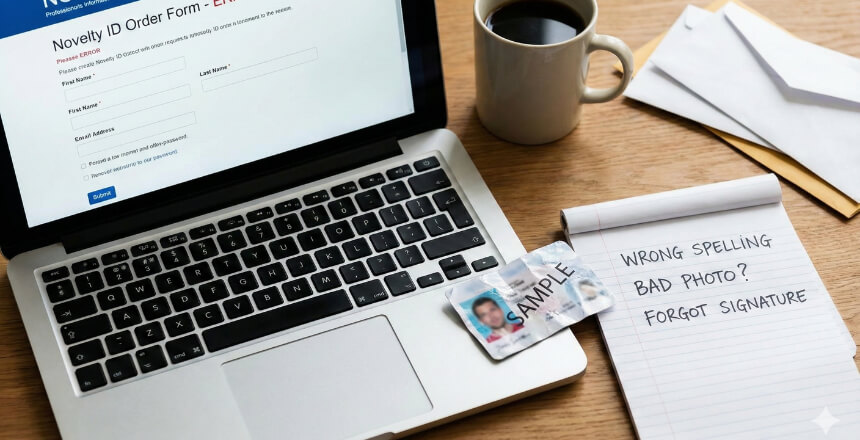
    They misspell names, mix up eye color, choose the wrong date of birth format, forget their shipping details, or upload a photo they didn’t mean to use.

    Then the messages begin:

    • “Can you change this?”
    • “Actually, use this other photo.”
    • “I misspelled my name can you fix it?”
    • “I forgot to add my city.”

    Sometimes it’s fine.

    But sometimes production has already started.

    The best way to avoid this?

    • Slow down for 30 seconds.
    • Read your details once.
    • That’s all it takes.

    When you’ve worked in this field long enough, you know rushed forms cause 80% of delays.

    6. Expecting Barcodes to Work Like Real Ones

    This is a misconception that comes from TV shows showing barcodes being scanned dramatically.

    People assume a novelty ID should:

    • scan
    • show data
    • behave like a PDF417
    • work with age-verification devices

    But novelty IDs are props, not identification.

    The barcodes are visual elements.

    They cannot and should not function like real license barcodes.

    Real barcodes belong to government systems, tied to identity databases. Novelty/prop cards purposely avoid those formats.

    What is possible is a decorative barcode for realism the kind seen in sci-fi films or corporate-themed badges. But it won’t scan.

    And that’s exactly how it’s supposed to be.

    7. Choosing Over-Complicated Designs That Look Worse When Printed

    This happens especially with people who love creative visuals.

    They request:

    • neon gradients
    • heavy shadows
    • texture overlays
    • extremely tiny details
    • holographic-style designs

    It may look great on your phone screen…

    but PVC printers don’t handle gradients and tiny patterns the same way digital screens do.

    This is why most professional novelty IDs use:

    • clean lines
    • high contrast
    • readable fields
    • simple backgrounds

    Good prop designers know this from years of test prints.

    Simple designs print sharper.

    Busy designs become fuzzy.

    8. Assuming Shipping Is Instant (Or Ignoring Location Limits)

    Another common issue:

    People think novelty IDs ship like Amazon Prime.

    Or they assume they’ll get worldwide shipping instantly.

    Actual production involves:

    • printing on PVC
    • laminating
    • cutting
    • quality checking
    • packaging
    • region-based shipping logistics

    And depending on your region, shipping may have:

    • different carriers
    • customs checks
    • longer delivery windows

    Beginners often don’t account for that and then panic when tracking isn’t instant.

    The best thing you can do?

    Order early.

    Especially if you need it for cosplay events, photoshoots, birthdays, or film projects.

    Production takes time because the goal is quality not speed.

    9. Expecting a Novelty ID to “Do More” Than It’s Meant For

    This is the mistake that can create real issues.

    Some beginners think a novelty ID can:

    • get them into a bar
    • act as real verification
    • bypass age checks
    • be used at security desks

    No.

    That’s not how novelty IDs work and it’s not what they’re for.

    A novelty ID is:

    • a prop
    • a collectible
    • a cosplay accessory
    • a film tool
    • a wallet filler
    • a creative item

    Nothing more.

    If you stay within these boundaries, everything stays fun, harmless, and completely legal.

    Final Thoughts: A Good Novelty ID Starts With Good Preparation

    Over the years, I’ve learned that most problems don’t come from the design team they come from tiny details customers overlook.

    And the truth is:

    A novelty ID is only as good as the materials you provide.

    A sharp photo.

    A clear signature.

    Fictional details.

    A simple design.

    A complete form.

    Get these right, and you’ll get a card you’re proud of whether it’s for cosplay, a video, a shoot, or just your collection.

    If you ever feel unsure, ask questions.

    A good designer would rather guide you now than fix issues later.

    That’s how you avoid every mistake on this list and end up with a novelty ID that looks exactly the way you imagined.

  • Best Use Cases for Novelty IDs in 2026

    Best Use Cases for Novelty IDs in 2026

    Novelty IDs are having a quiet comeback.

    Not as something sneaky, but as part of the creator economy: film students, cosplayers, photographers, escape-room designers, even Etsy sellers use ID-style cards as props, collectibles, or fan merch.

    You can see them all over marketplaces as “cosplay IDs”, “prop badges”, or “novelty ID cards” for costumes and themed events.

    If you use them the right way, they’re fun, safe, and completely legal. The key is how you use them.

    Below are the best, high-value use cases for novelty IDs in 2026, with real-world context, examples, and what to pay attention to in each case.

    Film, TV, YouTube and Short-Form Video Props

    If you work with video in any form, novelty IDs are one of the easiest ways to make a scene feel more believable.

    Think about:

    • a character flashing a “press” badge
    • a detective holding a case file ID
    • a student using a campus card at a gate
    • a sci-fi crew member with a ship access pass

    Professional prop teams do this all the time. There’s even behind-the-scenes content on how fake IDs are made for movies and TV, where designers talk about balancing realism with legal safety.
    YouTube

    For your own projects in 2026:

    • Use novelty IDs when your script needs characters with roles: agents, students, staff, crew.
    • Keep everything clearly fictional. No state seals, no DMV layouts, no government branding.
    • Focus on visual clarity: big photo, readable name, role, and maybe department or unit.

    You get all the realism the camera needs, without stepping anywhere near actual ID territory.

    Cosplay, Conventions and Fan Badges

    Cosplay is one of the biggest growth areas for novelty IDs.

    Fans now order:

    • FBI-style badges for supernatural shows
    • agency passes for sci-fi universes
    • Dunder Mifflin staff IDs
    • NASA, K-pop, anime, or game-world badges

    You can see this all over Etsy and fan shops, where creators sell prop badges for TV shows, games, and movies, clearly labeled as cosplay or costume accessories.

    For cosplay, a novelty ID does two things:

    1. Finishes the look. A character ID hanging on a lanyard or clipped to a jacket instantly makes a costume feel “complete”.
    2. Helps people recognise your role. At busy cons, not everyone knows every character. A clear badge can say “PRESS”, “AGENT”, “CREW” or the fandom name.

    To get the most out of it:

    • Match the design to the universe, but keep it clearly fictional.
    • Use your cosplay name or handle, not sensitive personal details.
    • Pick durable materials if you attend crowded events or multi-day cons.

    Collectibles and Fandom Merch

    Some people don’t even wear their novelty IDs. They collect them.

    There are full shops now built around cosplay and novelty ID cards for fans and collectors, printed on PVC or composite stock, often with screen-accurate layouts for specific shows, games, or fictional agencies.

    For collectors, the ID becomes:

    • a small piece of a fandom you can hold
    • something to display in a frame, binder, or shelf
    • a matching set (for example, all main characters from a show)

    If you design for this use case:

    • Think in sets: hero, side characters, different departments.
    • Add small lore references: unit numbers, project names, locations from the fictional world.
    • Make sure the card feels premium in hand (thickness, print quality, finish).

    In 2026, niche collectibles with story and quality often perform better than generic “funny ID” products.

    Photoshoots and Character-Driven Photography

    Photographers are using novelty IDs more often as part of character-based shoots:

    • a street photo series about “city workers”
    • a cyberpunk theme with neon badges
    • a mock security or staff portrait series
    • couples shoots where each person has a playful “role”

    Because the card sits close to the camera, it helps the viewer immediately read the character: “Oh, that’s a medic”, “That’s security”, “That’s crew”.

    For photoshoots:

    • Design with readability in mind. Big text, clear role, good contrast.
    • Make sure the photo you print on the ID matches the shoot’s styling (outfit, makeup, hair).
    • Avoid overloading the card. A few strong fields look better than a cluttered mess.

    If the final photos go online, novelty IDs are also safer than anything that uses your real personal data.

    Gifts, Inside Jokes and Personalized Surprises

    One of the most underrated use cases is simple: gifts.

    People order novelty IDs as:

    • “Employee of the Month” gag cards
    • fake “VIP” passes for birthdays or anniversaries
    • “Official Cat Mom / Dog Dad” badges with pet photos
    • role cards for weddings, stag/hen parties, reunions

    You can even see “custom novelty driver’s license” products marketed openly as party props, gag gifts, cosplay, or themed events.

    For gifts, the magic is in the details:

    • a nickname only friends use
    • a made-up department like “Snack Quality Assurance”
    • a funny “clearance level” or “rank”
    • an expiry date that matches a birthday or event

    Here content matters more than strict design accuracy. The goal is a smile, not realism.

    Escape Rooms, Events and Themed Parties

    Escape-room designers and event planners use novelty IDs as part of the experience:

    • access cards for secret labs
    • undercover agent badges
    • staff passes for fictional corporations
    • visitor passes for alien bases or disaster zones

    Marketplaces are full of downloadable or physical prop badges for mystery parties, spy games and escape rooms, often sold as “CSI”, “secret agent” or “mission” ID props.

    For this use:

    • Think about game flow. Does the card unlock a clue, mark a role, or just decorate?
    • Make each card type visually distinct. Players should tell roles apart quickly.
    • Use colour coding or icons for teams, departments, or difficulty levels.

    A good event ID feels like part of the world building, not just a random plastic rectangle.

    Theatre, Acting Classes and Role-Play Training

    Acting schools, drama groups and role-play trainers use ID-style cards in rehearsal:

    • to help actors stay in character
    • to visualize professions or ranks
    • to support immersive exercises (for example, hospital staff, pilots, crew, reporters)

    Because an ID sits on the chest, it quietly reminds the actor “who” they are in the scene.

    If you design for this context:

    • Keep roles clear and readable from a distance.
    • Use simple, bold layouts that work under stage lighting.
    • Consider lamination or hard plastic if cards are reused every term.

    For corporate or soft-skills training, fictional ID cards can also reduce anxiety. Participants step into a “role” that feels safer than just being themselves.

    Wallet Fillers and Everyday Character Building

    This one is quieter but common: people use novelty IDs simply to personalize their wallet.

    They like opening it and seeing:

    • a sci-fi agency badge
    • an in-universe staff pass from their favorite game
    • a “press” card for a creative side they’re proud of

    It has no function in the real world. It just reminds them of a story or version of themselves they like.

    In 2026, with more people treating identity as a mix of online and offline personas, these tiny objects act like physical extensions of their digital life.

    If you design for this:

    • Focus on aesthetics and durability.
    • Keep the design clean, so it still looks good after months of wear.
    • Avoid dates or text that will feel outdated too quickly.

    A Quick Word on What Novelty IDs Are Not For

    Because search results mix “fake ID” and “novelty ID” content, it is important to be clear.

    Under U.S. federal law, 18 U.S.C. § 1028, the problem is fraud and identity misuse, not film props or fan cards.

    So in 2026, the safe rule stays the same:

    Novelty IDs are fine when used as props, collectibles, costumes, or game pieces.

    They become a problem only when someone tries to pass them off as real identification for age checks, travel, banking, or law enforcement.

    Keeping that boundary clear is good for you, your audience, and your brand.

    Choosing the Right Use Case for You in 2026

    If you are planning novelty IDs this year, ask yourself one simple question:

    “Where will this card actually live?”

    On camera?

    On a lanyard at a convention?

    In a display frame?

    In a game room?

    In someone’s wallet as a private in-joke?

    Once you know that, you can:

    • decide how realistic it needs to look
    • choose what information to include
    • pick materials and finishes that make sense
    • design something that feels thoughtful, not generic

    Used well, novelty IDs are not just plastic cards. They are tiny story devices.

    Frequently Asked Questions

    1. What can novelty IDs be used for in 2026?

    Novelty IDs are mostly used for filmmaking, cosplay, collectibles, themed photoshoots, escape rooms, gifts and event badges. They’re props not identification.

    2. Are novelty IDs safe to use for cosplay or videos?

    Yes. They’re widely used in conventions, short films, TikTok sketches and theatre. Just don’t use them in real-age or identity checks.

    3. Are novelty IDs legal to own in the U.S.?

    Yes. They’re legal as long as they aren’t used to misrepresent age or identity. They must also avoid real state ID designs.

    4. Can novelty IDs include real personal information?

    They can, but many people use fictional details for privacy, especially for photoshoots and collectibles.

    5. What makes a good novelty ID design?

    A clear photo, readable role/title, fictional details, clean layout, and a finish that matches the theme sci-fi, corporate, fan-universe, or cinematic.

  • Are Novelty IDs Legal? A Simple 2026 Guide for Beginners

    Are Novelty IDs Legal? A Simple 2026 Guide for Beginners

    If you’ve ever typed “novelty ID legal or not?” into Google, you’re not alone.

    Most people don’t really know where the line is, and honestly, the internet doesn’t make it easier.

    One website says it’s illegal, another says it’s fine, someone else on Reddit says you’ll go to jail and suddenly you’re more confused than when you started.

    Don’t be confused, in this article, I’m going to explain if keeping novelty IDs legal or offense.

    Let’s get started.

    What Exactly Is a Novelty ID? (Human-Style Explanation)

    A lot of confusion around “fake IDs” comes from the fact that people throw the term around loosely. In reality, a novelty ID is just a prop card the same type of thing you’d see in a YouTube comedy sketch or a low-budget film.

    It looks like an ID, but it isn’t tied to any government system, doesn’t copy state layouts, and isn’t meant to get you past a bouncer.

    Imagine you’re filming a short movie about high school kids. You can’t use a real state ID on camera, so you create a harmless prop.

    That’s basically what a novelty ID is. Nothing sneaky. Nothing illegal about owning one.

    So… Are Novelty IDs Actually Legal?

    Yes buying one, keeping it in your room, collecting them, or using it in a video is 100% legal in the United States.

    The only thing the law cares about is intent.

    • Not the card.
    • Not the design.
    • Not the idea of having one.

    It only becomes a problem if someone tries to use anything to lie about their age or identity.

    If you want to see exactly what the law talks about fake identification cards, here’s the federal statute:

    If you read it, you’ll notice one theme:

    The part that’s illegal is misrepresentation, not owning a harmless prop.

    What Makes a Novelty ID Safe to Own?

    A novelty ID stays on the legal side when it doesn’t try to copy an actual state license. That means no seals, no real holograms, no DMV barcode formats.

    Most novelty creators already avoid these things on purpose not just to stay compliant, but because they don’t need them.

    These cards aren’t meant for scanning or verification, so using decorative barcodes or fictional numbers is more than enough.

    Another good sign is when a website openly states that its products are props or collectibles. Real counterfeiters hide. Legit novelty/prop brands are very clear about what they’re selling.

    And of course, the biggest point of all: you don’t use it as real identification.

    Keep it for fun, display, film work, or a photoshoot, and you’re fine.

    When Can a Card Get You into Trouble?

    Trouble only happens when someone presents a card any card in a situation where a real ID is required. That’s when state laws come in.

    For example, trying to enter a bar with a novelty ID is illegal. Not because the card is illegal, but because you’re attempting to mislead someone. Many universities warn students about this exact issue.

    So the rule is simple and very human. Owning it is fine. Using it to trick someone is not.

    Why Movie Teams Use Novelty IDs And What That Means for You

    If you’ve ever paid attention to shows on Netflix or Hulu, you’ll notice actors holding “ID cards” that clearly aren’t real state licenses.

    Prop designers follow the same standards that novelty ID creators do: keep things realistic enough for the camera, but avoid anything that mimics real government features.

    The Art Directors Guild talks openly about creating safe, non-replica props for productions.

    This is the same category novelty IDs fall under the film prop category, not the “counterfeit document” category.

    Examples of Completely Legal Uses (Explained Naturally)

    Think about all the creative places where a novelty ID fits perfectly:

    A film student shooting a bar scene

    • A cosplayer creating a character badge
    • A TikTok skit that needs a close-up shot
    • A photographer doing a character-themed portfolio
    • A quirky gift for a friend
    • A collectible to add to someone’s hobby wall
    • An acting class prop for role-play

    None of this is harmful. None of it is intended to fool anyone. And that’s exactly why it’s legal.

    How to Stay 100% Safe When Buying One

    If you want to stay fully safe, think of novelty IDs the same way you’d think of movie props.

    Don’t expect them to work as official government ID.

    Don’t include sensitive personal details you don’t need to share.

    And make sure the place you’re buying from clearly positions their product as fictional, not as a replacement for real ID.

    That’s really all you need to know.

    If you use common sense, you’ll never cross the legal line.

    The Big Takeaway

    • Novelty IDs are legal.
    • Owning them is legal.
    • Buying them is legal.

    Using them in videos or creative projects is legal.

    The only thing that is NOT legal is using any card to impersonate someone or gain access to restricted services. That’s a misuse problem, not a novelty ID problem.

    If you treat it like a collectible or prop which is what it is you’re fully in the clear.

    Frequently Asked Questions

    1. Is it legal to buy a novelty ID online?

    Yes. Buying and owning a novelty ID is legal because it’s considered a prop or collectible.

    1. Can you get in trouble for having a novelty ID?

    No, not for owning one. Legal issues only happen when someone uses a card to misrepresent their identity.

    1. Do novelty IDs have to follow specific rules?

    They should avoid copying real state designs and must be clearly fictional.

    1. Can you travel or enter bars with a novelty ID?

    No. Novelty IDs aren’t for verification and shouldn’t be used in real-world checks.

    1. Can I use my real information on a novelty ID?

    You can, but many people use fictional details for privacy.

    Final Words!

    If there’s one thing to take away from all of this, it’s this:

    Novelty IDs are legal because they’re props.

    Misrepresentation is the only thing the law cares about.

    So if you’re getting one for a project, a costume, a skit, or just because you think they’re fun to collect, you’re not doing anything wrong. Just keep your use honest and stay away from anything that looks like a real government document.

    That’s all the law expects, and it’s a very easy line to stay within.

  • What Details Should You Include for a Realistic Novelty ID Design?

    What Details Should You Include for a Realistic Novelty ID Design?

    A simple, expert-led guide for beginners who want believable, safe, and well-designed novelty IDs.

    Designing a realistic novelty ID feels confusing until someone breaks it down properly.

    Most people think, “Just put my name and photo, right?” but the difference between a cheap novelty card and a believable prop comes from choosing the right details, not the most details.

    This guide comes from real experience hundreds of cards, different templates, different use cases, and a lot of trial and error.

    I’ll walk you through what actually matters, why it matters, and how to choose details that give your novelty ID a clean, polished, realistic feel without crossing legal boundaries.

    Start With the Purpose: What Will This ID Be Used For?

    Before filling any fields, you need to know your “use case.”

    This one question changes everything.

    • You need details that look good on camera and hold up in close-ups.
    • Fictional details matter more than real-world accuracy.
    • Aesthetic balance matters more than technical detail.

    Google’s search patterns show people often ask:

    “What details should be on an ID card?”

    “How to design a fake ID that looks real?”

    “What info is needed for an ID?”

    But for novelty IDs, the rules are different.

    You only add details that help tell the story and make the card look visually convincing.

    The Essentials: The Details Every Realistic Novelty ID Needs

    These are the details that instantly give a novelty ID credibility.

    They’re not legally sensitive they’re just basic identification fields that almost every ID-style document uses.

    Name (First + Last)

    Even if everything else looks great, a missing or weirdly formatted name makes the card feel unfinished.

    Keep it simple and clean.

    Photo (High Quality)

    This is the heart of the ID.

    A crisp, well-lit photo instantly raises the realism.

    For beginners:

    Use the guidelines photography experts recommend for portrait ID photos:

    Use a proper camera if possible. Avoid selfies and portrait mode blur.

    Date of Birth

    You can use your real DOB or one that fits your prop/character.

    This is safe and widely used in novelty products.

    Issue & Expiry Dates

    Real IDs almost always have these, which is why adding them helps.

    Don’t overthink it, just keep the dates reasonable.

    A Unique ID Number

    This doesn’t have to follow any government pattern.
    It can be:

    NOV-392182, FIC-102847, ID-88473

    Random + short = perfect.

    Signature

    This makes the card look personal.

    A simple signature drawn with a black marker on white paper works great.

    Optional Details That Add Believability (Only If Needed)

    These aren’t required, but they help when you want your card to feel more complete especially for film props or collectibles.

    Physical Traits

    Height, weight, hair color, eye color.

    These fields are extremely common on many ID types (driver’s licenses, membership IDs, etc.)

    Address

    If you add an address, keep it fictional.

    It gives context but never use real sensitive info.

    Organization or Role

    For workplace, club, event, or fictional agency props.

    Barcode or QR Code (Non-functional)

    Important:

    Use decorative codes only never anything linked to verification.

    You can generate fictional QR codes safely here:

    (Just don’t encode sensitive data.)

    Access Level or Class

    This helps for props like staff IDs, security badges, membership cards, etc.

    What You Should Never Include (Very Important)

    To stay on the right side of laws and search engine policies, avoid:

    • real state seals
    • real government holograms
    • PDF417 barcodes (used in state IDs)
    • MRZ lines (passport-style codes)
    • copying layouts from government ID templates
    • real identification numbers used anywhere else

    You can read the official law here:

    Your goal is realistic but clearly novelty just like movie props.

    What Actually Makes a Novelty ID Look “Real”? (Not What People Think)

    Most beginners focus on the wrong things fonts, colors, lamination.
    Designers focus on something much simpler:

    Clean spacing

    Good spacing makes the card feel professional.

    Clutter kills realism immediately.

    Balanced fields

    Not too many, not too few.

    Aim for 6–10 well-chosen fields.

    Consistent story

    If the character is 22, don’t use a 2010 issue date.

    If the name is short, don’t force long descriptors.

    Photo quality

    A blurry photo ruins even the best design.

    These are the same principles used in professional ID design:

    Novelty IDs follow the same logic minus the functional verification elements.

    The Designer’s Checklist (Simple Enough for Anyone)

    Here’s an easy checklist beginners can follow:

    ✔ Name
    ✔ Good photo
    ✔ Date of Birth
    ✔ Issue date
    ✔ Expiry date
    ✔ ID number
    ✔ Signature
    ✔ Optional: height, hair, eyes
    ✔ Optional: fictional address
    ✔ Optional: non-functional barcode
    ✔ Optional: role/title

    If you include these, your card will look balanced and believable.

    Final Tips So Your Novelty ID Looks Polished

    These small details make a big difference:

    • Use short, clean fields
    • Avoid overly long names or titles
    • Don’t cram every possible field
    • Keep data consistent
    • Don’t mimic any real state or government format
    • Choose fictional but realistic values (height, eye color, etc.)

    A realistic novelty ID is not about faking anything. It’s about design clarity, good details, and visual storytelling.

    Frequently Asked Questions

    1. What information should go on a novelty ID?

    A realistic novelty ID usually includes your name, photo, date of birth, issue/expiry date, a fictional ID number, and a signature. You can add optional details like height, eye color, or a decorative barcode if it fits your use-case.

    2. How do I make a novelty ID look believable without copying a real one?

    Use clean spacing, a sharp photo, fictional numbers, and simple details that make sense for your prop or character. Avoid real state seals, real holograms, or barcode formats used on government IDs.

    3. Should I use my real information on a novelty ID?

    You can, but it’s safer to use fictional data especially for addresses or ID numbers. Many people use character names for cosplay or film props.

    4. What photo works best for novelty ID design?

    A well-lit, front-facing photo taken with a real camera works best. Avoid selfies, heavy filters, and portrait-mode blur. Good lighting makes the biggest difference.

    5. Do I need an ID number on a novelty ID?

    Yes, it helps with realism. It doesn’t need a special format—just avoid real government numbering styles. Something like “NOV-402913” works perfectly.

  • How Our Design Team Creates Realistic Prop IDs Without Breaking Any Rules

    How Our Design Team Creates Realistic Prop IDs Without Breaking Any Rules

    Most people only ever see the finished prop ID.

    Sharp photo, clean layout, the little details that make it feel like something official but not too official.

    What they don’t see is the hours of decisions, edits, corrections, and “nope, that’s not allowed” conversations happening behind the scenes.

    So instead of giving you the polished marketing version, I’ll walk you through how we actually design these cards the way I’d explain it if you were sitting next to me watching the process unfold.

    Let’s dive in.

    1. Realism Doesn’t Come From Copying It Comes From Discipline

    One of the first things we teach new designers at fakeids.com is this simple truth:

    If you copy a real ID, you’ve already failed.

    Real IDs are protected by federal law and we respect that.

    Some states even protect layouts, hologram shapes, and microtext patterns. Designers need to know that and respect it.

    What we do instead is study structure rather than identity:

    • how spacing creates hierarchy
    • how colors guide the eye
    • how photos sit in a frame
    • how typefaces affect readability
    • how background patterns add depth without distracting

    When you understand these, you can create something that feels believable without ever crossing a line.

    This is the same approach movie prop designers use for passports, FBI badges, and boarding passes. They follow the visual logic not the original design.

    And honestly?

    It gives us more creative freedom.

    2. Your Photo Is the Heart of the Card (And The Hardest Part of Our Job)

    I’d be honest here, 70% of the quality of your final card depends on the photo you upload.

    And I say this as someone who has spent too many nights fixing:

    • sideways selfies
    • photos taken in yellow bathroom lighting
    • “portrait mode” images with fake blur
    • blurry nightclub photos
    • pictures where someone cropped their forehead off

    When a good photo comes in, the design process becomes smooth.

    When a bad one comes in, we fight with it for 20 minutes.

    Here’s what we actually do with your photo:

    Photo Workflow (Actual Steps)

    • import into Photoshop
    • adjust exposure (usually +0.15 to +0.35)
    • fix color temperature (most photos are too warm)
    • lift shadows under the chin
    • soften harsh flash
    • clean the background
    • apply skin-tone balancing using selective color
    • crop using gridlines (eyes in the top third)
    • sharpen edges without overdoing clarity

    It’s not magic.

    It’s just careful retouching the same way photographers prep headshots.

    When customers follow the instructions (“use a real camera, don’t stand too close”), everything becomes easier.

    3. Building the Card Layout The Part You’d Be Shocked To See

    People think we “use templates.”

    We don’t. Templates create sameness and mistakes.

    We build every layout manually, based on a fictional design system.

    However all our Ids will have all every details which will make it almost perfect to real ID.

    Here’s how it usually goes:

    1. Start with a blank 1012×638px canvas

    This gives us enough space to design at print resolution.

    2. Create a background layer

    This is NOT a state background.

    We design our own patterns:

    • geometric wave lines
    • overlapping hex patterns
    • soft gradients
    • modern vector textures

    Sometimes we reject 4–5 backgrounds before choosing the one that feels balanced.

    3. Add structural guides

    This is where it gets technical.

    We use:

    • 8pt padding grids
    • 16pt spacing grids
    • 4-column layouts
    • vertical rhythm guides

    These grids keep the whole card clean and readable.

    4. Typography

    We use fonts that are:

    • open-license
    • modern
    • readable
    • NOT used on state IDs

    Inter, Roboto, Source Sans fonts you see in tech interfaces, not government documents.

    5. Placing customer data

    This part requires judgment.

    Two IDs never look the same because:

    • long names wrap differently
    • different eye colors affect spacing
    • birthdays with double digits need special alignment
    • some customers include middle names, others don’t

    It’s like fitting text into a UI card everything has to feel natural.

    6. Adding fictional security artwork

    This is the fun part for us:

    • UV-style waves
    • hologram-inspired shapes
    • micro-pattern layers
    • abstract seals
    • texture overlays

    These are custom-created assets.

    We never reuse official symbols. You’d be surprised how many times designers say:

    “Nope, remove that too close to something real.”

    Compliance matters.

    4. The Compliance Phase: The Part We Take Very Seriously

    Every card goes through a quick internal checklist before printing.

    Here are things we absolutely NEVER include:

    • state seals
    • flags, coats of arms
    • barcodes with real format
    • PDF417 codes
    • MRZ passport lines
    • real hologram icons
    • DMV text strings
    • official color patterns
    • state-shaped shadows or outlines
    • serial formats used by US IDs

    If a design even feels like it’s drifting close to something official, we rebuild it.

    5. Why Our Cards Feel “Real” Even Though They’re Not

    Let me tell you a secret, realism doesn’t come from copying a government ID it comes from good graphic design.

    • The way shadows fall.
    • The spacing around the photo.
    • The sharpness of the edges.
    • The background depth.
    • The consistency of the text.

    These are real design principles the same ones taught in UI/UX and brand identity work.

    Someone with a good eye for spacing can make anything look legitimate without using any protected elements.

    That’s why our cards feel smooth, clean, and polished.

    6. Printing: The Part Customers Never Think About

    Printing is a science.

    If you’ve ever held a cheap novelty card from another site, you’ve felt:

    • dull colors
    • flat surfaces
    • blurry edges
    • low-res lamination
    • inconsistent thickness

    We don’t do any of that.

    Here’s our typical print workflow:

    • Convert artwork to CMYK
    • Apply print-safe color profiles
    • Print onto Teslin or composite PVC
    • Add laminate layers
    • Trim edges
    • Round corners
    • Inspect manually
    • Print duplicate
    • Pack discreetly

    This is why our cards last for years and don’t peel.

    7. Human Mistakes Are Caught Because Humans Review Everything

    Every designer has a story of catching something weird:

    • a customer accidentally typed “1997” twice
    • a space got added at the end of a last name
    • a height was submitted as “6’09”
    • a middle name was the same as the last name
    • the eye color didn’t match the photo

    We fix obvious mistakes quietly before printing.

    You’d be shocked how many times this saves an order.

    8. Your Data: What Actually Happens Behind The Scenes

    Here’s the real truth nobody here wants your data.

    The designers only see:

    • your text
    • your photo
    • your signature (if added)

    That’s it.

    And after we print your cards:

    • files are kept temporarily
    • deleted automatically in short intervals
    • never fed into AI
    • never stored long-term
    • never reused for anything

    Designers care about making the card look good not keeping your information.

    9. Why This Entire Process Matters

    Prop IDs aren’t toys.

    People use them for:

    • film and photography
    • cosplay
    • collectibles
    • creative projects
    • character design
    • novelty gifts
    • theatre productions

    So they need to look good, feel good, and print well without ever crossing into replica territory.

    That balance realism along with compliance is the whole reason our design workflow exists.

    And honestly?

    It’s why we’ve been doing this for years without issues.

    Frequently Asked Questions

    1. Do you copy real state IDs when designing prop IDs?

    No. Our designers only use original artwork, fictional elements, and custom patterns. We study design principles, never government templates or protected symbols.

    2. What makes a prop ID look realistic if nothing is copied?

    Realism comes from professional graphic design clean spacing, sharp photos, balanced colors, and layered textures. These are visual principles, not replicas of official IDs.

    3. What security-style features do you include?

    We use cinematic, fictional elements like abstract hologram-style shapes and geometric patterns. None of them match real government holograms, barcodes, or seals.

    4. How do designers edit the uploaded photo?

    A real designer adjusts exposure, color balance, clarity, and alignment manually inside Photoshop. There are no auto-filters or AI tools in the editing process.

    5. How do you ensure the designs stay legal?

    Before printing, every card goes through a compliance review to ensure no state symbols, protected layouts, barcode formats, or government identifiers are used.

    6. What printing material do you use for prop IDs?

    We print on Teslin or composite PVC, laminate for durability, and check each card by hand. You receive two copies your main card and a free duplicate.

  • Step-by-Step: How to Order a Custom Prop ID on FakeIDs.com (A Real User’s Guide)

    Step-by-Step: How to Order a Custom Prop ID on FakeIDs.com (A Real User’s Guide)

    If you’ve never ordered a custom prop ID before, you’re not alone. It’s one of those things that looks simple from the outside, but once you click around, you start wondering: “Okay… how do I actually do this the right way?”

    That’s what this guide is for.

    I’m not going to throw technical terms at you or talk like a support bot. This is just a normal, human walkthrough of how the process works what details matter, how to take a good photo, what happens behind the scenes, and what you can expect once you hit “submit.”

    Once you understand the flow, ordering becomes super easy, and honestly, a little fun.

    Before You Start: Know What You’re Ordering

    A lot of confusion comes from the word “ID.”

    So let’s clear that up right away:

    FakeIDs.com creates prop, collectible, and novelty IDs. These are for film projects, cosplay, photoshoots, character building, gifts, and display. They’re not government-issued documents and not meant for verification.

    If you’re curious about where the legal lines are, this explains it clearly: Legal Boundaries of Collectible IDs in the US

    Once you understand you’re making something fun and creative — not something serious — you’ll find the whole process much easier to approach.

    Your Photo: The Part That Makes or Breaks the Card

    Let’s keep it real: the photo is the biggest factor in how your card will look.

    Designers can fix a few things, but they can’t magically turn a blurry selfie into a crisp, professional-looking prop. Think of your photo as the “face” of the entire project.

    Here’s what works best (practically speaking):

    • Use a real camera when you can (selfies distort your face)
    • Stand against a plain wall
    • Wear something simple and dark so your face stands out
    • Don’t stand too close (6–8 feet works well)
    • Good lighting is everything avoid yellow or colored lights
    • Don’t tilt your head, keep it neutral

    If you want a deeper breakdown with visual examples, here’s the full guide: How to Take the Perfect Photo for Your Custom Prop ID

    Take your time on this part. A good photo makes the final card look sharp and believable.

    Your Signature: Optional, But Adds Personality

    Not every prop ID needs a signature, but when you include one, it gives the card a nice finishing touch.

    Just sign your name on clean white paper using a black marker.
    Snap a clear picture (flash off).

    That’s it.

    No need to overthink it.

    Filling Out the Order Form (And What Each Field Actually Means)

    Now head to Order Page.

    The form looks longer than it really is. Everything is there to help the designer create a clean, well-balanced card, and every field serves a purpose.

    Let me break it down like a real person would:

    Names & Basic Details

    These appear exactly as you type them.

    Misspellings on the form mean misspellings on the card.

    Birthdate, Height, Weight, Eye Color, Hair Color

    These aren’t for verification they’re for character building and prop realism.

    A lot of filmmakers enter their character’s details, not their personal ones.

    Address (Optional)

    If this is for a story or character, feel free to invent an address that fits the scene.

    If you don’t care, the team can generate a fictional one.

    Template Choice

    Choosing a “state” doesn’t mean you’re getting a state ID replica.
    It’s just the design style everything remains novelty-based.

    Photo & Signature Uploads

    These go directly into the design workflow.

    Nothing is shared, nothing is reused, nothing is sent elsewhere.

    If you want to know exactly how your data is protected, read this: How We Keep Customer Data 100% Private

    Optional Custom Numbers (+$20)

    If you’re working on a film set or creating a prop for a storyline, this lets you add specific dates, ID numbers, or continuity details.

    The form is basically you telling the designer how you want your character to “look” on paper.

    Understanding Pricing Before You Pay

    Once you’re done with the form, check the pricing page.

    The breakdown is simple:

    • Standard card price
    • Free duplicate with every order
    • Optional upgrades
    • Bulk discounts
    • Secure payment process

    If you’re ordering for a group (like a cast or a themed event), you’ll save more when ordering multiples.

    How Payment Works (And Why It’s Private)

    Checkout feels like any normal online purchase.

    Payment is processed through secure systems, and none of your full card details are stored on the site.

    Depending on your location, you’ll see different options, including privacy-friendly digital payments.

    If you want a dedicated guide for payment steps, the site links to it during checkout.

    What Happens After You Submit the Order

    This is the part nobody explains, but everyone wonders about.

    Here’s a real behind-the-scenes look:

    1. A human designer opens your photo

    They adjust lighting, crop it, fix minor issues, and prepare it for layout.

    1. Your details are placed carefully

    Spacing, alignment, color balance it’s all done manually.

    1. The card is printed on durable material

    Teslin, PVC, or Polycarbonate the same feel as high-quality prop cards used in productions.

    1. A physical quality check happens

    Misprints, scratches, blur, misalignment everything is inspected.

    1. The card is packed discreetly and shipped

    No flashy labels, nothing revealing.

    Just a normal envelope.

    Most orders ship within 3–5 business days.

    You can find shipping info is here.

    What If Something Goes Wrong?

    Because your card is custom-made, refunds aren’t possible for typos or incorrect details you typed in.

    But the team will replace your order if:

    • the card arrives damaged
    • the print quality is off
    • the details don’t match what you submitted

    I’d suggest you to checkout our refund policy to know more.

    Take a quick photo when reporting issues it speeds things up.

    Your Data: Where It Goes and What Happens After

    This is the part people care about most, and rightfully so.

    Your uploaded photos and details are:

    • used only to make your prop card
    • stored temporarily during production
    • deleted within a short window once your order is complete
    • never reused, sold, shared, or fed into any system

    Everything is handled privately and then removed, no exceptions.

    Our Privacy Policy has everything you want to know.

    Frequently Asked Questions

    1. How long does it take to process a custom prop ID?

    Most orders are designed, printed, checked, and shipped within 3–5 business days. Large group or bulk orders can take a little longer depending on volume.

    2. What type of photo works best for a prop ID?

    A clear, well-lit photo taken with a real camera works best. Stand 6–8 feet from the camera, use a plain wall, avoid colored lighting, and keep your head straight.

    3. Can I use character details instead of my real information?

    Yes. Many customers enter fictional details for cosplay, film projects, and character design. The form only needs accurate spellings to build the card correctly.

    4. How secure is the order process on FakeIDs.com?

    Your uploads and order details are used only to create your prop ID and are deleted shortly after fulfillment. Nothing is stored long term or shared with third parties.

    5. What if I make a mistake on the order form?

    If you spot an error immediately, contact support before production starts. Once printing begins, the team can’t change details, but they will replace misprints or damaged items.

    Final Thoughts: Once You Know the Steps, It’s Easy

    Ordering a prop ID shouldn’t feel intimidating.

    It should feel creative like building a character or crafting a small piece of a story.

    Once you know:

    • how to take a solid photo
    • what the form fields mean
    • how production works
    • what happens to your data
    • when to expect shipping

    …the rest is smooth and simple.

    If you’re ready to create your own card, Order Your Custom Prop ID now.

  • Why Transparency Matters in the Novelty ID Industry in 2026

    Why Transparency Matters in the Novelty ID Industry in 2026

    Let’s be honest the novelty ID space isn’t like selling socks or scented candles.
    It’s an industry where people naturally have questions, doubts, and concerns.

    They want to know:

    • Who’s behind the website?
    • How are photos handled?
    • Is the product safe and legal to own?
    • Will their data get deleted?
    • Are the cards novelty-only or something else?

    Most websites hide behind vague text like “we value your privacy” or copy-paste legal templates that say nothing real.

    But people aren’t stupid.
    They can sense when something feels shady.

    That’s why transparency isn’t just a “nice to have” for a novelty ID business it’s the foundation of trust, legitimacy, and long-term survival.

    Here’s what transparency actually looks like, why it matters, and how FakeIDs.com practices it daily.

    What Transparency Really Means in a “Grey Zone” Industry

    Most e-commerce brands talk about transparency in vague terms “we care about your privacy”, “we value trust”, “we never misuse your data.” You can copy-paste that onto almost any website.

    In the novelty ID space, generic claims don’t cut it.

    Here, transparency has a few very specific dimensions:

    • What are these IDs actually for? Are they meant to be collectible and fun, or are they trying to skirt the law?
    • How close are the designs to real IDs? Are you copying state layouts and seals, or creating original artwork that clearly belongs to the prop/collectible category?
    • What happens to photos and signatures after upload? Are they deleted? Stored? Shared? Used for anything else?
    • Who is behind the site? Is there a real team, or just a brand name with no accountability?

    If a site can’t answer those questions clearly, it becomes hard to trust it as a user and just as hard for platforms like Google to separate it from truly harmful activity.

    But that’s not the case with us, you can learn everything about us and can checkout our disclaimer and privacy policy to know how we operate.

    Why Customers Need Radical Clarity

    From a customer’s point of view, ordering a novelty ID is a mix of excitement and anxiety.

    They’re thinking things like:

    • “Is this legal to own where I live?”
    • “Will my photo end up somewhere it shouldn’t?”
    • “Is this site going to vanish after I pay?”

    If a website doesn’t answer those concerns directly, the customer is left to guess and most people assume the worst.

    That’s why we’ve leaned heavily into education, not just sales. I’d strongly recommend to check these articles:

    Fake ID vs Novelty ID The Real Difference

    Legal Boundaries of Collectible IDs in the US

    How We Keep Customer Data & Photos 100% Private

    You’ll see what we do, what we don’t do and where the legal and ethical lines are.

    That kind of clarity doesn’t just “sound good.” It helps people make informed choices, and it keeps them out of trouble. When someone understands that our cards are collectible props, not government documents, they’re far less likely to misuse them.

    How Lack of Transparency Hurts Everyone

    It’s easy to think transparency is optional until you look at the damage done by sites that hide everything.

    When a site:

    • never explains how designs are created
    • never mentions novelty-only use
    • never talks about deletion of photos
    • never lists a real contact method

    …then both users and the industry pay the price.

    Customers get scammed, photos are reused or leaked, and eventually that behavior shapes how platforms see every site in the niche even the honest ones.

    We’ve already seen what happens when search engines decide “this entire category looks risky.” Manual penalties, deindexing, and lost trust follow very quickly. The only way to stand apart from that is to be painfully, consistently clear about your intent and your process.

    That’s why our FAQs doesn’t dodge hard questions. If something isn’t allowed, we say it. If something is legal only under certain conditions, we explain those conditions.

    What Transparency Looks Like in Practice on FakeIDs.com

    For us, transparency isn’t a banner; it’s baked into the way the site works.

    1. We openly define what we sell.

    We don’t pretend to be an ID service. Our Disclaimer tells you plainly that our products are novelty and collectible items, made for props, gifts, cosplay and fun not for real-world identification or age verification.

    2. We explain how we handle your data instead of saying “we care about privacy.”

    Our Privacy Policy and dedicated blog on data handling walk through how uploads are encrypted, isolated, and deleted. We don’t expect you to “trust us”; we show you why you can.

    3. We are upfront about processes.

    On the Order Page, you can see exactly what information is needed, why it’s needed, and what happens next. There’s no surprise extra step after payment where you suddenly learn about a risky requirement.

    4. We don’t hide behind a faceless brand.

    Our About and Contact pages exist for a reason: you should know who you’re dealing with, and you should always have a way to reach us.

    5. We publish our rules on refunds and shipping.

    Instead of improvising when something goes wrong, we keep clear, written standards in our Refund Policy and shipping info, so people know what to expect before they buy.

    Individually, these might look like “just pages.” Put together, they send a much stronger message:

    “We’re not hiding anything. Here’s how everything works. Decide based on that.”

    Why Transparency Also Matters for SEO and Manual Reviews

    The reality is: novelty ID websites live under a microscope.

    When Google reviewers look at a site in this space, they’re asking:

    • Is this clearly about collectibles and props, or does it look like it’s facilitating illegal activity?
    • Does the site explain legal boundaries, or does it encourage rule-breaking?
    • Does it have full policies, disclaimers, contact info, and an owner story?
    • Are there real, helpful articles, or just thin sales copy?

    A site that hides its intent, its policies, and its identity is far more likely to be flagged, even if it isn’t actively doing anything illegal.

    By contrast, a site that:

    • distinguishes novelty vs illegal use
    • publishes guides about legal boundaries
    • explains data handling
    • makes its business practices visible

    …gives both users and search engines something concrete to trust.

    That’s one of the reasons we’ve invested time into a small but meaningful blog library around safety, legality, privacy, and clarity rather than only publishing “sales” content. In the long run, it’s better for customers and better for search.

    The Long-Term Play: Building a Brand, Not Just a Storefront

    Anyone can throw up a website, take orders for a few months, then disappear.

    That’s not what we’re trying to build.

    Transparency is our way of saying:

    • we’re here to stay
    • we’re willing to explain how we work
    • we’re prepared to stand behind our products
    • we know where the legal and ethical lines are, and we keep them in view

    When you read our Legal Boundaries article, check our Disclaimer, skim our Privacy Policy and send a question through Contact you’re not just dealing with a checkout page. You’re dealing with a brand that takes responsibility.

    That’s what we want FakeIDs.com to be known for not just design quality, not just fast service, but honest transparency in a niche that desperately needs it.

    Final Thoughts

    Transparency in the novelty ID industry isn’t about looking good. It’s about doing the right thing for customers, for search platforms, and for the long-term health of the whole niche.

    We create novelty and collectible IDs. We say that openly.

    We explain how we design them, how we protect your data, and how we expect them to be used.

    And if you’re ever unsure about anything legality, safety, data, or process there’s always a real page, a real explanation, and a real way to reach us.

    That’s what transparency means to us.

    Not a slogan. A way of operating.